
The Berbak National Park comprises an area of 190.000 ha. of peat (110,000 ha) and freshwater swamp (60,000 ha). A smaller part consists of mangrove forest. The park is situated on the east coast of Sumatra in the province Jambi.
Nine months of the year large areas of the park are flooded. Therefor, the best time to visit the park is during the dry season from June till October. Berbak is very hot and humid.
The park's inaccessibility makes it one of the best refugees for several endangered animals. Berbak might be considered as one of the best Tiger and Tapir reserves in Indonesia. Moreover, it's avifauna is very rich.
The park is inhabited by the a group of approximately 150 original inhabitants of the east Sumatra swamps: the nomadic Kubu tribe.
Tourism Access
Boats leave Jambi for Nipah Panjang and from Nipah Panjang to Desa Air Hatam Laut (expensive!), the entrance of the park. Desa Air Hitam Laut can be reached in approximately five hours, although travel time may double during the wet season.A PHPA permit is obligatory and available from the PHPA office in Jambi.
The park is also accessible by the river Sungai Batang Hari.
Tourism Accomodation
Simple accomodation in Nipah Panjang.
Several possibilities in Jambi.
Tourism Flora
Nypa fruticans, Pandanus tectorius, Mammea spp.
Tourism Fauna
Berbak is most famous for it's variety of birds: 250 species belonging to 49 families. A sail along the rivers in the park is the easiest way to watch the birds.
Apart from birds you find several other animals but in lower numbers than in the lowland forests.
Tourism Mammals:
Sumatran Tiger, Malayan Tapir, Sumatran Rhinoceros, Malayan Sunbear, Clouded Leopard, Leopard Cat, Siamang, Agile Gibbon, Common Otter (Lutra lutra), Hairy-nosed Otter (Lutra sumatranus), Yellow-throated Marten (Martes flavigula), Fishing Cat (Prionailurus viverrinus), Banded Palm Civet (Hemigalus derbyanus), Long-tailed Macaque, Pig-tailed Macaque, Pangolin, Greater Slow Loris, Banded Leaf Monkey, Banded Linsang (Prionodon linsang), Large Flying Fox, Cream-colored or Common Giant Squirrel (Ratufa affinis), Silvered Leaf Monkey, Bottle-nose Dolphin (Tursiops truncatus).
Tourism Reptiles
False Ghavial, Estuarine Crocodile, River Terrapin, Bornean Terrapin, Black Marsh Turtle, Reticulated Python, Rough-necked Monitor (Varanus rudicollis), Water Monitor.
Tourism Birds
White-winged Wood-Duck, Chinese Egret (Egretta eulophotes), Lesser Adjutant, Milky Stork, Storm's Stork, Asian Dowitcher, Nordmann's Greenshank (Tringa guttifer), Wrinkled Hornbill, Wallace's Hawk-eagle, Helmeted Hornbill, Great Hornbill, Shikra (Accipiter badius), Chinese Goshawk, Crested Goshawk, Besra (Accipiter virgatus), Asian Pied Hornbill, Black Hornbill, Jerdon's Baza (Aviceda jerdoni), Black Baza (Aviceda leuphotes), Barred Eagle-owl (Bubo sumatranus), Rhinoceros Hornbill, Common Buzzard (Buteo buteo), Black-winged Kite, Spotted Kestrel (Falco moluccensis), White-bellied Sea-eagle, Brahminy Kite, Grey-headed Fish-eagle, Black Eagle, Buffy Fish-owl, Blue-crowned Hanging Parrot, Black-thighed Falconet, Brown Boobook, Collared Scopsowl, Reddish Scopsowl (Otus rufescens), Osprey, Oriental Honey-buzzard, Red-breasted Parakeet, Long-tailed Parakeet, Blue-rumped Parrot (Psittinus cyanurus), Crested Serpent-eagle, Blyth's Hawk-eagle (Spizaetus alboniger), Changeable Hawk-eagle, Peregrine Falcon (Falco peregrinus), Silvery Pigeon (Columba argentina), Oriental Hobby, Argus Pheasant.
Tourism Fishes:
Arowana, Finless Porpoise (Neophocaena phocaenoides).
Berbak National Park
Komodo National Park
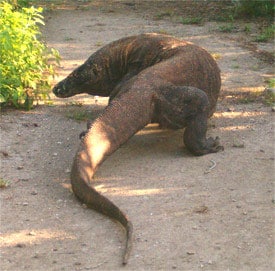
Komodo National Park has widely known with the home of the giant lizard Komodo Dragon - which has just declare to be one of the latest heritage of the world. Explore the under water live and its ecosystems which has well known as the best diving site in the world. From beautiful coral, reefs, thousands sort of fishes to the crystal water and beautiful beach are await to visit. Komodo dragons live in one of the driest area in Indonesia, where there are few permanent water sources. The mix vegetation of Komodo National Park provides habitat and shade for different animals of the park. There are 254 plants species from Asian and Australian origin. Komodo dragons are carnivores and do not eat any of the vegetation. However, the main prey of Komodo dragon, such as deer and will boar, feed on various leaves, fruit, flowers, roots and grasses found in the park.
Most of the Park is dry, rugged and hilly, a combination of ancient volcanic eruptions and more recent tectonic uplift of sedimentary seabeds. The irregular coastline is indented with rocky headlands and sandy bays, many framed by soaring volcanic cliffs.
Komodo island is 35km long and 15km wide, and is mountainous on a north to south axis, with an average altitude of 500-600m. The highest peak is Satalibo (735m) in the north. Most of the island is lontar palm savannah with remnates of rainforest and bamboo forest at higher elevations. On Rinca the land rises gradually from the north coast to a plateau that ends at Mount Dora (667m) in the south. The rugged south coast is very sheer as a result of volcanic activity in the distant past, as evidenced by the crater bay in which Nusa Kode nestles.
Natural Tourisme Object Bali Barat National Park

The natural tourisme object Bali Barat National Park lies at the western side of Bali and is 77,000 ha, some 10% of Bali's total land area. The park is the last refuge of one of the most endangered birds of the world: the Bali Starling.
Bali Barat is mountainous and consists of primary monsoon forest, mangrove forest, savannah and coral islands.
The peninsular Prapat Agung, with its extensive web of footpaths, is the most accessible part of the park. Here at Tegal Bunder, you will find the Bali Starling Recovery Project where the PHPA is trying to reintroduce Bali Starlings.
Pulau Menjangan, an island north of the mainland part of the park, is an excellent place to explore the coral reefs.
Fauna
Bali Barat National Park is a paradise for bird-watchers. They will find about 160 different species in the park.
Birds
Bali Starling or Rotschild's Myna (Leucopsar rothschildi), Yellow-vented Bulbul (Pycnonotus goiavier), Black-naped Oriole (Oriolus chinensis), Pied Fantail (Rhipidura javanica), Edible-nest Swiftlet (Collocalia fuciphaga), White-bellied Swiftlet (Collocalia esculenta), Pacific Swallow (Hirundo tahitica), Crested Treeswift (Hemiprocne coronata), White-breasted Wood-Swallow (Artamus leucorhynchus), Barn Swallow (Hirundo rustica), Red-rumped Swallow (Hirundo daurica), Long-tailed Shrike (Lanius schach), Striated Warbler (Megalurus palustris), Collared Kingfisher (Halycon chloris), Sacred Kingfisher (Halycon sancta), Javan Kingfisher (Halycon cyaniventris), Small Kingfisher (Alcedo caerulescens), Rufous-backed Kingfisher (Ceyx rufidorsus), Stork-billed Kingfisher (Pelargopsis capensis), Racket-tailed Treepie (Crypsirina temia), Dollarbir
Animals
Banteng (Bos javanicus), Wild Boar (Sus scrofa), Rusa Deer (Cervus timorensis), Long-tailed Macaque (Macaca fascicularis), Ebony Leaf Monkey (Trachypithecus auratus), Barking Deer or Muntjac (Muntiacus muntjak), Hawksbill Turtle (Eretmochelys imbricata), Leopard Cat (Prionailurus bengalensis), Pangolin or Trenggiling (Manis javanicus), Large Flying Fox or Kalong (Pteropus vampyrus), Black Giant Squirrel (Ratufa bicolor), Water Monitor (Varanus salvator).
Access
Bali Barat National Park is easy accessible from Gilimanuk, the ferry port where ferries to and from Java come and go. Gilimanuk is reached by ferry from Java or by bus from Denpasar or Singaraja. From Gilimanuk take a minibus or ojek to Cekik for the last three kilometer. Here you will find the PHPA headquarters. An other entry point is Labuhan Lalang, accessible by minibus from Gilimanuk. Labuhan Lalang lies at the main road to Singaraja, which cuts through the park. To reach Pulau Manjangan you can hire a motorboat from Labuhan Lalang (30-40 min).
Permits and obligatory guides are available at the PHPA headquarters at Cekik, at the PHPA office in Labuhan Lalang or at the PHPA office in Denpasar.
Place of Interest in Siberut Cheap National Park
 Indonesia is a place of many cheap national park in the world. One of the interesting cheap national park in Indonesia is Siberut National Park.
It is located in Siberut island and the distance from West Sumatra is about155 km across the mentawaian strait. The trip to Siberut take 10 hours on the regular ferry departing Padang 4 times a week. Boot charters may be arranged from Padang port.
A PLACE OF INTEREST
Community and Culture
Although Siberut is only a small island, the internal variations in language, culture, life styles, and in resources is rather substantial. There is no clear indication of when the first man arrived on Siberut, but anthropologist suggest that the bataks of North Sumatra first settled on the island several thousand years ago. In many ways, the people of Siberut are among the most archaic people in Indonesia.
The Mentawaian are traditionally organized as patrineal groups and the social life centered around the UMA, a communal long house which held a clan of people related through a common ancestor. The UMA vary in size between 30 to 80 members divided in nuclear family units, referred to as LALEP. Because of internal friction, the clan might split up and form a new group or a single family.
The Mentawaians believe that all living objects, men, plants and animals are supposed to have spirits. The only specialist in the community is the medicine man, KEREI, responsible for communication with the spirits and the souls. In case of misfortune or illness, he is called in to restore harmony within the group or in relation with the spirits in the environment. An elaborate Taboo system based on religious beliefs with respect to the environment is a dominant characteristic of traditional life on Siberut.
Visit and stay in a Mentawaian village, trek to the jungle, learn about sago processing and bark cloth processing, and do other activities that will heighten your interest in and fascination with the natural philosophy of the Mentawaians.
Jungle Adventure
Very few visitors have explored the thickly frested island. Inside the National Park pleasant surprises await the adventures visitor. Visiting a cave in central Siberut or waterfalls in the northern and southern parts of the island, are possible upon request with your guide. Be observant of your surroundings. You may have the chance to see and hear some endemic wild life. Siberut has four endemic primates which in local names are called Bilou (Hylobates klossi), Simakobu (Simias concolor), Bokoi (Macaca pagensis), and Joja (Presbytis potenziani). There are at least five species of squirrels and chipmunks and birds abound everywhere on the island.
Padding a canoe trekking on muddy trails balancing on a shippery log, wading through a shallow river, brushing through a dense jungle - are all parts of an unforgettable jungle adventure on Siberut.
Coastal Discovery Adventure
Some good coral reefs can be found along the east, south to southeast part of Siberut and the surrounding small islands. Along the coast, continuous, white sand beaches, magnificent lagoons, enficing mangroves and coral sea gardens all promise an exciting coastal adventure. Dolphins (Stenela longirostris) can be seen along the east coast. Other sea mammals such as digong (Dugong dugong) occasionally can be sighted near the sea grass by the mangrove along with three protected species of sea turtles.
Masilok Beach on the southern part of Siberut can be reached within an hour by a motorized boat. The island's resort, dominated by coconut grows, a logoon with beautiful white sand beach, promising a very relaxing environment. The west coast breaks from Siberut island, connected only by sea garden and mangrove that lie side by side making it a unique experience for diving. Accommodation and fresh clean water are available. If you plan to travel to nearby islands, it can be arranged with local owners. In the south western part of Siberut lies Sagulubek Beach, with calm and clear waters making it ideal for wind surfing. In the northern part, Sikabaluan beach offers an excellent dip in warm water to soothe the soul.
Another activity is oaring with traditional sampan through the mangrove, zig-zagging past the enormous and thick prop roots. Enjoy the scenery and bring back pictures to show off to friends.
Enjoy the Cheap National Park at Siberut.


